
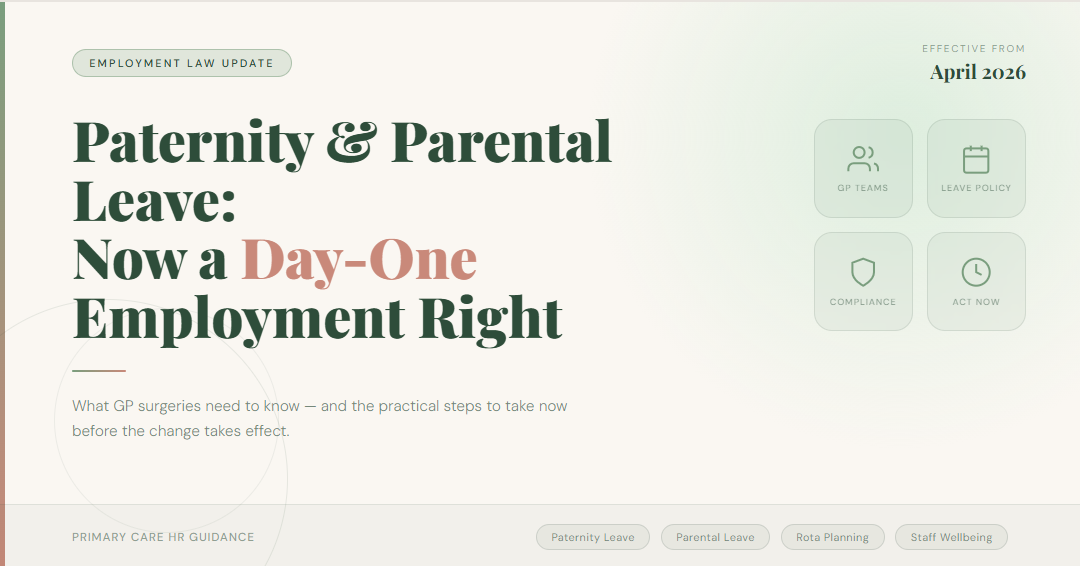
Preparing for Day-One Parental and Paternity Leave
From April 2026, paternity leave and unpaid parental leave are expected to become day-one employment rights. While this may sound like a technical amendment to employment law, it has real implications for GP surgeries already working under pressure. Immediate eligibility changes how practices plan rotas, manage new starters and maintain fairness across the team. Preparing now will help you stay compliant, avoid disruption and reinforce a supportive culture from day one.
From April 2026, paternity leave and unpaid parental leave are expected to become day-one employment rights. At first glance, this may appear to be a minor technical change. In reality, for GP surgeries it has meaningful operational and cultural implications.
Primary care teams are already managing rota gaps, recruitment pressures and growing patient demand. A shift in eligibility rules means new starters may be entitled to certain types of leave immediately. Practices that prepare early will handle requests calmly and fairly. Those that do not risk confusion, inconsistency and avoidable stress.
This is an opportunity not only to remain compliant, but to demonstrate that your practice supports staff from the very start of their employment.
Practices should confirm final details via GOV.UK, ACAS and NHS Employers once formal regulations are issued.
What Is Changing?
According to the announced reform, from April 2026:
Paternity leave will become a day-one right.
Unpaid parental leave will also become a day-one right.
The key change is the removal of the minimum qualifying service requirement. Eligible employees will have access to these statutory leave rights from their first day of employment.
It is important to be clear about one point:
“Day one” eligibility does not remove statutory notice requirements. Employees will still need to request leave formally and comply with the required notice periods set out in legislation. The structural process remains. What changes is when eligibility begins.
Why This Matters for GP Surgeries
For GP practices of all sizes, the impact is primarily operational rather than financial.
Operational and Staffing Implications
A new receptionist, nurse or administrator could request leave shortly after starting.
Rota pressure may increase if leave coincides with other absences.
Smaller partnerships may feel this more acutely.
Clear escalation pathways for cover will become more important.
HR and Governance Considerations
Staff handbooks may contain outdated qualifying-period language.
Contracts may require review to ensure consistency with updated policy.
Policy review dates should reflect this legislative change.
Inconsistent handling of requests increases legal and reputational risk.
Payroll and Record-Keeping
Payroll providers must be aligned with the updated eligibility rules.
HR records should document requests, decisions and dates clearly.
Notice procedures should be understood by all line managers.
Culture and Wellbeing
Handled well, this change can strengthen your practice culture.
Early access to family-related leave sends a clear message that the practice values work-life balance. Transparent and fair processes reduce anxiety. Clear communication prevents misunderstanding. In a workforce where retention is increasingly important, how you handle these requests matters.
This is not just about compliance. It is about leadership.
Final Thought
Employment law changes can feel like another item on an already full compliance list. But this reform is different. It speaks directly to how practices support staff during significant life events.
Handled proactively, this change strengthens governance, improves clarity and reinforces a culture of fairness. In a sector where recruitment and retention remain challenging, that cultural signal matters.
Preparing early means that when the first day-one request arrives, your practice responds with confidence rather than uncertainty.

Turn Intention Into Action
It All Begins Here
Confidence doesn’t always arrive with a bold entrance. Sometimes, it builds quietly, step by step, as we show up for ourselves day after day. It grows when we choose to try, even when we’re unsure of the outcome. Every time you take action despite self-doubt, you reinforce the belief that you’re capable. Confidence isn’t about having all the answers — it’s about trusting that you can figure it out along the way.
The key to making things happen isn’t waiting for the perfect moment; it’s starting with what you have, where you are. Big goals can feel overwhelming when viewed all at once, but momentum builds through small, consistent action. Whether you’re working toward a personal milestone or a professional dream, progress comes from showing up — not perfectly, but persistently. Action creates clarity, and over time, those steps forward add up to something real.
You don’t need to be fearless to reach your goals, you just need to be willing. Willing to try, willing to learn, and willing to believe that you’re capable of more than you know. The road may not always be smooth, but growth rarely is. What matters most is that you keep going, keep learning, and keep believing in the version of yourself you’re becoming.

Everyone Tells You to Start Journalling.
It All Begins Here
Journalling is often recommended as a wellbeing habit.
It’s meant to reduce stress.
Improve clarity.
Strengthen emotional awareness.
But most people are left staring at a blank page thinking, What am I actually supposed to write?
At Wellbeing de la vie, we see journalling not as a trend, but as a structured pause. A way of creating space in a busy working life to think clearly and feel honestly.
You don’t need to write beautifully.
You don’t need a complicated format.
You just need a starting point.
Here are a few that work.
1. Start With Emotional Honesty
Before productivity. Before planning. Before fixing.
Ask yourself:
What is sitting on my mind today?
What feels heavy?
What feels steady?
What am I not saying out loud?
Write for five minutes without editing. This is not a report. It is not evidence for anyone else. It is simply awareness.
Emotional clarity is the foundation of sustainable wellbeing.
2. Try the Three-Line Reflection
If time feels scarce, keep it contained.
One thing that went well
One thing that stretched me
One thing I appreciate
This builds resilience quietly. Over time, you begin to see patterns of growth, not just pressure.
3. Use It as a Clarity Tool
Wellbeing is not only emotional. It is also cognitive.
You might explore:
What actually matters this week?
Where am I overextending myself?
What conversation am I avoiding?
What would “calm and competent” look like here?
This becomes a private check-in before the world pulls you in different directions.
4. Notice Patterns
After a few weeks of consistent reflection, you will start to see:
Recurring stress triggers
Energy peaks and dips
Themes in your thinking
Decisions you delay
This is where journalling shifts from writing to insight.
Insight allows choice.
Choice restores agency.
Agency strengthens wellbeing.
5. If You Feel Completely Stuck
Use a sentence starter:
Right now I need…
I am worried about…
I am proud that…
If I am honest…
Let the sentence guide you. You do not need more structure than that.
A Final Thought
Journalling is not about producing pages. It is about creating a small daily pause where your thoughts are not interrupted, corrected or rushed.
Wellbeing is rarely built through dramatic changes. It is built through consistent, quiet awareness. Five honest minutes is enough!
If you begin, begin gently, Open the page, Write one true sentence. That is enough.

Make Room for Growth
It All Begins Here
Confidence doesn’t always arrive with a bold entrance. Sometimes, it builds quietly, step by step, as we show up for ourselves day after day. It grows when we choose to try, even when we’re unsure of the outcome. Every time you take action despite self-doubt, you reinforce the belief that you’re capable. Confidence isn’t about having all the answers — it’s about trusting that you can figure it out along the way.
The key to making things happen isn’t waiting for the perfect moment; it’s starting with what you have, where you are. Big goals can feel overwhelming when viewed all at once, but momentum builds through small, consistent action. Whether you’re working toward a personal milestone or a professional dream, progress comes from showing up — not perfectly, but persistently. Action creates clarity, and over time, those steps forward add up to something real.
You don’t need to be fearless to reach your goals, you just need to be willing. Willing to try, willing to learn, and willing to believe that you’re capable of more than you know. The road may not always be smooth, but growth rarely is. What matters most is that you keep going, keep learning, and keep believing in the version of yourself you’re becoming.